
Taking Vegan Products Off the Market: What are the Reasons?
General
The food market is experiencing a boom in the supply of vegan options and products, and it seems that more and more restaurant chains and cafés are embracing the trend. However, there is an “elephant in the room” that we have to address at some point: many vegan products are launched in chains, restaurants, or supermarkets only to disappear soon after.
This is a huge problem for some vegan consumers, but also for non-vegan people who feel like eating plant-based. The sudden removal of these options from the menus, after having been released and available for a few months, often without explanation, leads us to several questions that we will try to analyse down below.
We would like to clarify before we start that the photos are always all ours, either of our clients or of the events that we go to work, and that, in this case, they have no relation to the vegan products that have been withdrawn from the market.
One of the examples that is a clear example of this phenomenon is Starbucks Spain, which in 2019 launched several vegan products the vegan and plant-based community celebrated like this:
Starbucks Spain once again bets on an offer in which customers can find vegan products adapted to their tastes, needs, and lifestyle
The options were:
‘Vegan Mini-Whim’: Raspberry-filled brownie sponge cake with dark chocolate raspberry glaze
‘Vegan Sandwich’: Multi-grain ciabatta sandwich with spiced pumpkin, blueberry jam, fresh vegetables, and vegan chipotle dip, according to the specialised vegan news portal VegMadrid.
Like many other people, I was encouraged to go to the Starbucks closest to my parents’ house, next to the Reina Sofía museum in Madrid, to sample these new vegan products.
When I arrived, I asked the waitress what the vegan options were, to which she answered: “Those, but meh” and a gesture halfway between disdain and disgust. I understand that this gesture – especially to the person who is vegan-curious or vegan-friendly, (not a hardcore vegan like I have been for so many years) can discourage even the most curious foodie.
This little anecdote has been repeated in many places I have been.
Here’s a brief run-down of some classics:
- I was served a completely uncooked vegan meat patty, and when we asked the waiter what had happened, he told me “this is vegan and it comes out like that”. This of course was not true, vegan meat does not refuse to be cooked like that. I’ll save you the photo, but it was one of the best-known vegan meat brands.
- They have also given us the vegan chicken without cooking and half raw in a chain that we went to recently with my mother in a shopping center. We were only there because it was the only place in the whole food court that even had a vegan option.
- Changes have been made to a menu item, without disclosing that it was no longer vegan, at a chain in London. That was a surprise.
- We have ordered a burger, which seems to be the only option in many places, and the bread is not vegan. THE BREAD?!
In the end, they are making a sort-of-vegan product that neither people who are allergic to lactose nor vegans will be able to eat, and, to be honest, a hamburger without a bun is not the experience you want in one of the most famous American food places.

If the chains themselves do not train people to sell the vegan products well, let alone cook them, regardless of their personal tastes, they are shooting themselves in the foot.
So the final question is obvious:
Why do food and beverage companies remove vegan options from their menus after a while?
Furthermore, if they don’t train their team well, another possible explanation is that companies may be responding to pressure from non-vegan consumers. According to a 2019 study by the consultancy Euromonitor, 9% of Spanish consumers consider themselves vegan or vegetarian, which means that there is still a vast majority of consumers who prefer non-vegan food and drink options.
Although there are other data, like Spaniards are drinking less cow’s milk than ever. In this Statista graph, you will see consumption fall and fall, despite the efforts of the dairy lobby to keep consumption up.
I asked the owner of a vegan restaurant in Valencia, Marian Cervera from Khambú, about this phenomenon of plant-based options, since she is one of the people who has been selling vegan food for the longest time and who uses third-party products in her day-to-day business.
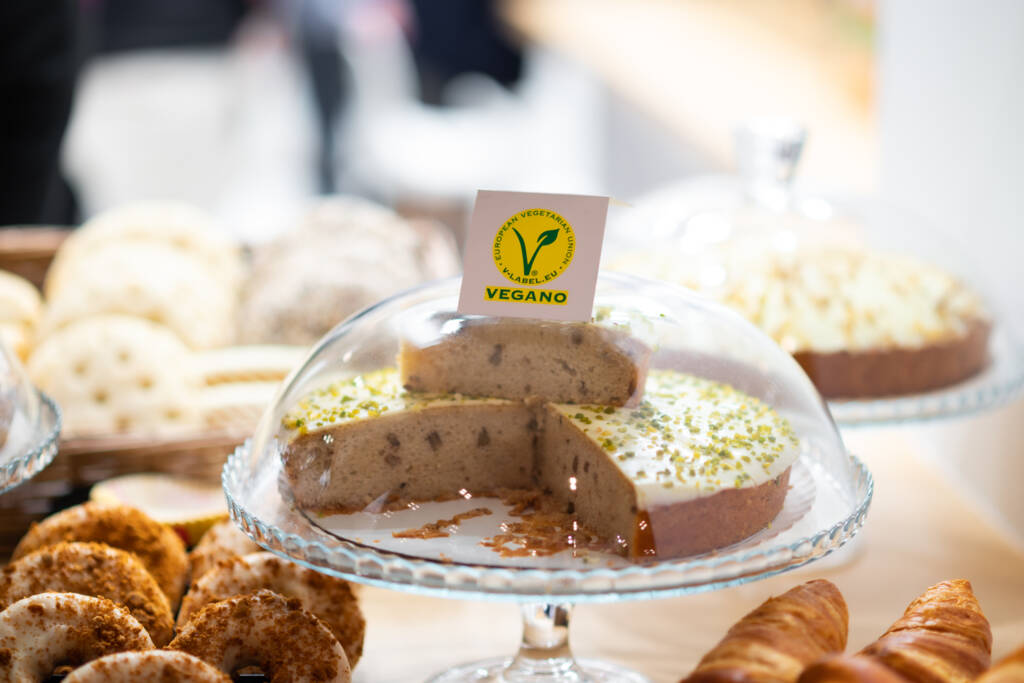
“In the case of vegan products, Europastry seems like a good example to me since they value them. For example, I had a muffin with chocolate chips that had a pattern drawn on the base paper in which the word vegan was repeated. It was great, our clients loved it and we sold a lot. Delicious flavor, well priced and also kept very well for several days without losing quality, unlike other products that dry out quickly, these retained their juiciness.”
“After a few months they withdrew them and they told me that it was a product that sold very little,” she tells us. “My question is: does the fact that it has ‘vegan’ written on it affect sales? Possibly. Because many people have this notion that vegan products can be less tasty or boring.”
What Marian raises is another of the big questions: does the vegan label discourage people? Is the perception of the most vegan-distant consumer that veganism is boring, that vegan products are not tasty or that, they are simply not for them ‘because you have to eat everything?’
We have also asked the Communications Manager of the Spanish Vegetarian Union, Laura Jiménez, about this topic:
“The vegan badge can affect a sector of the population, but its perception has evolved in recent years. Now there are supermarkets and companies that want to certify all their products.”
Laura summarises the importance of this badge and the correct labeling like this:
“The ‘vegan’ does not have to be aimed at this specific public, since most of the people who consume products with the badge are ‘flexitarian’, and the purpose of classifying a product as vegan is to inform and offer transparency and this in some way can be key to expanding the market. There will always be part of the population that thinks a certain way and rejects vegan products, but the trend is upward, both in terms of companies and consumers.”
Obviously, in a vegan restaurant, the people who eat there will worry about other types of labels and information like allergens, but for the rest of us, it is important. Marian tells us about the Europastry product:
“In Khambú it was selling very well because it’s a vegan restaurant, but I imagine that the same is not the case in normal bakeries and other places”, she says. “Normally the company doesn’t give any type of information about product withdrawals. In fact, the usual thing is that they continue to appear on the website and you order them but then they don’t arrive and they tell you that there is no stock, until one day they tell you that the product will definitely not come back. I think that this would be a point to improve in their communication because sometimes you don’t know if it really is a lack of stock or if the product is not going to return. There are some that stay on the website for months and are no longer sold or even manufactured.”
Another potential issue is that vegan options and products can be perceived as a “threat” to non-vegan consumers. Instead of feeling like they have more choice, they may believe that vegan products are limiting and that companies are changing their menus to fit a specific niche market. This is like when you want to take your brother-in-law to a vegan restaurant and he answers with great concern: “And what am I going to eat?” Well, anything, José María, you’re going to a restaurant, not to choose a prison menu.
We already know how some people are, so perhaps the pressure from them to stop going to places that now also offer vegan dishes and products, could reduce sales. Food and beverage companies might therefore feel pressure to satisfy their non-vegan consumer base and remove vegan options from their menus in order to keep their regular customers.
What data supports veganism as a good business strategy, to be implemented properly?
When we say properly, we mean treating vegan products with the same care or more that we would treat any other product launch within our companies: with strong communication strategies that don’t lack creativity, training staff, putting innovation into customer service, and hiring people who are experts in plant-based gastronomy to help us understand how these products work, how they behave and how to get the most out of them.
Why include vegan products and not leave them out? Because sooner or later, this type of diet will end up being adopted by most of the population, it has to be.
Let’s get some data:
There are countless studies on why a 100% plant-based diet is the most sustainable for the planet, so I’ll mention just a few, so as not to make this article endless:
- Oxford University: Reducing food’s environmental impacts through producers and consumers, Science.
- IPCC. (2019). Climate change and land: an IPCC special report on climate change, desertification, land degradation, sustainable land management, food security, and greenhouse gas fluxes in terrestrial ecosystems.
- FAO Report: Tackling climate change through livestock – A global assessment of emissions and mitigation opportunities.
- University of Minnesota: Water Footprints of Nations, Ecological Indicators.
- Oxford University and the University of Minnesota: Analysis and valuation of the health and climate change co-benefits of dietary change, Proceedings of the National Academy of Sciences.

According to a 2020 report by the consulting firm Nielsen, the vegan food and beverage market in Spain has grown by 15% in the last two years, reaching a value of 570 million euros in 2019. This shows that there is a growing market for consumers looking for vegan options.
Furthermore, the same report revealed that 67% of Spanish consumers are willing to pay more for vegan and vegetarian products, which means that offering vegan options may not only attract vegan consumers but also those looking for healthier and more sustainable options.
The report The vegan sector in Spain 2021 by ProVeg International, highlights that ‘the vegan market in Spain is booming and more and more companies are interested in launching vegan products. In 2020 there was a 30% increase in the number of vegan companies in Spain.’
According to the data analysed by the Spanish Vegetarian Union, from the Smart Protein Global report: ‘As for Spain, 30% of the people surveyed declared that they were flexitarian and 6% followed a diet based on vegetables (vegan or vegetarian).’
Another interesting survey is the Global Consumer Survey, conducted in 2021 by Statista for World Vegan Day (November 1). ‘1.5% of those interviewed followed a vegan diet, while two years ago, however, that percentage was 0.8%.’
In ‘The Livekindly Collective Annual Impact Report,’ a global food and media company dedicated to promoting plant-based eating, significant growth in business in Spain is seen, with an increase of 400 % in their sales in 2020 compared to the previous year.’
Of course, we have to mention our ‘Second Report of Vegan Companies in Spain 2023’ in collaboration with the Comillas Pontifical University and Dr. Estela Díaz in which 75% of the surveyed entrepreneurs see the outlook for veganism as favorable to very favorable over the next two years. In addition, we have experienced a vegan boom with 60% of businesses having been created in the last 4 years (from 2019 to 2023).
In summary, vegan products can be withdrawn from the market for the reasons we have mentioned above: less demand, trying to satisfy a non-vegan consumer, problems with the supply or quality of vegan products, lack of training for staff who have to cook or sell them, and bad communication of that product that makes it go unnoticed.
Withdrawal of vegan products by some companies doesn’t signify a setback for veganism or the plant-based sector as such, though. As to whether or not this is a bad business strategy, I suppose that companies have only to look at the data that predict consumer behavior trends shows us, but also at data that is confirmed by more and more international organizations and scientists from around the world regarding the Climate Emergency.
Eating vegan, plant-based or 100% vegetable (whatever we want to call it) is going to be the only quick, relatively easy to implement and the most effective option in the fight against the challenges posed by the world food crisis and the problems of inequalities and social justice that we face.
So I’ll say goodbye with another question, for you the reader to answer: is it a bad business strategy to remove vegan products so that the short-term profit prevails VS. the survival of the company and the planet?
I really am sorry for how biased the question is, but I think our position on this issue is pretty obvious.
If you want to know more about the circumstances that are preventing the plant-based sector from continuing to lead the conversation and experiencing exponential growth we leave you this article from our blog so that you know what we have to do in the plant-based sector.
Let us know in the comments if your favorite vegan products have been withdrawn and which ones.