
What’s it like to be a brand ambassador?
General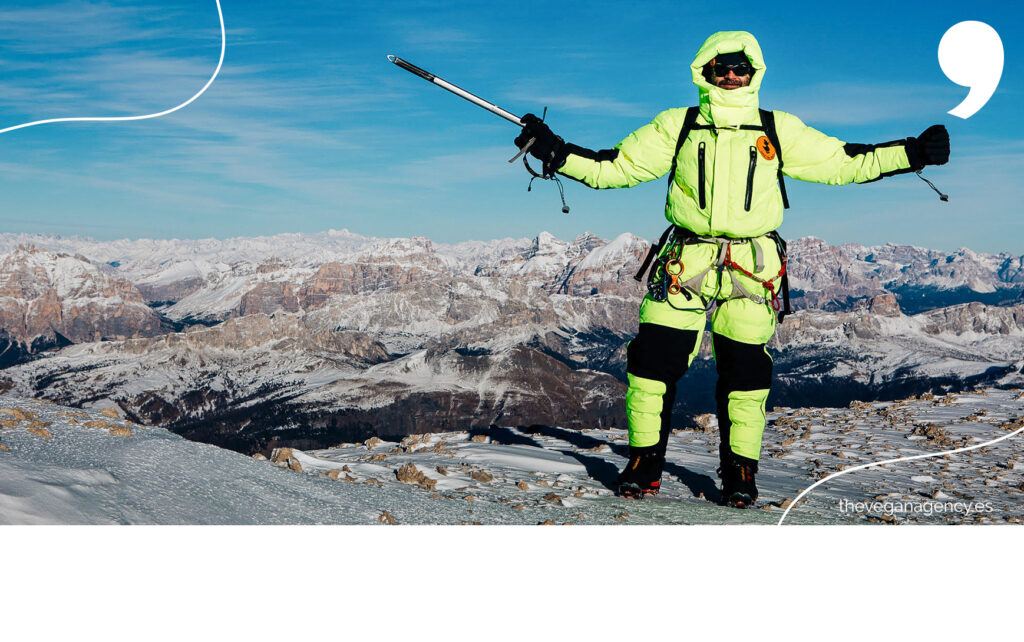
Kuntal Joisher is the first Indian vegan mountaineer. Kuntal used to be a software engineer, but after a trip with his wife to the Himalayas he changed his life forever and morphed into the Kuntal we know today: a record-breaking vegan athlete and animal rights ambassador. He partners with NGO such as Million Dollar Vegan too!
In his quest to prove that vegans can do anything non-vegans can (if not more), he partnered with Save the Duck, an Italian clothing brand, which made him a custom one-off mountaineering suit completely free of any and all animal products. We wanted to know a bit about what that partnership was like, so we asked him!
- Why did you choose Save the Duck as a brand to collaborate with and how long have you been working with them?
I reached the very top of Mt. Everest on May 19th, 2016 wearing a down feather suit. Ever since that day, I spent my time feeling serious guilt about using a down suit, as well as mittens with leather palms. Guilt, however, was not the solution. The solution was to find a reliable and safe vegan alternative to both down and leather that would keep me warm and safe while above 8000 meters; inside the death zone in the thin cold air.
Once I was back home from Everest, I was contemplating a climb to the top of Mt. Lhotse (4th highest mountain in the world) in Spring 2018. This time around I was not going to compromise and wear a dead animal on my body. So I started my search for an animal-free suit again.
Right then I wrote to an Italian company called Save the Duck which specialised in building animal-free insulation jackets. They didn’t have mountaineering gear in their catalogue, but they agreed to build a custom suit for me since we both shared the same vision and values – 100% animal-free. I was ecstatic! After about 8 months of R&D, they made the world’s first-ever one-piece suit for 8000m mountains; down-free and 50% of the suit was made from recycled materials – discarded plastic bottles and fishing nets.
- What values do you share with the brand?
100% Animal-free and ultra-high performance can go together.
- Tell us a bit more about the specific advantages of their clothing for your specific needs.
Let me tell you a story! On the morning of May 14th, our team was caught in a severe windstorm while we were climbing from Camp 3 to Camp 4 on Mt. Lhotse. Visibility was almost zero, and the wind was gusting incredibly strongly, with speeds of up to 70km per hour! For a second I really thought I was going to be ripped off the mountainside. One of the Sherpa guides and his client climber behind me were also talking about quitting. But I was determined – I was not going anywhere but up. High winds meant that the entire route had disappeared and everything was covered in powder snow. My crampons were not getting any purchase on the terrain, and for the first time in the expedition, I was worried that I was going to get super cold super fast, and I’d have to turn around and go home.
That did not happen. The one-piece synthetic suit from Save The Duck worked wonders – it shielded me from both the wind and the biting cold. Right then and there I knew that I had a world-class product on my body and that I was going to make it to the top warm and safe. The next day, around 3.00 am we started from Camp 4 and headed to the top of Lhotse. It was dark and bone-chillingly cold, but I was warm and toasty in my suit. After a few hours of climbing, at around noon, I took the final steps and I was on top of Lhotse! Honestly, this had been one of the most difficult expeditions of my life. I was knackered at the top. However, my biggest joy was that I climbed without using down or leather, and had become possibly the first human ever to complete an expedition to the top of any 8000-meter high mountain as a 100% vegan!
- How many products do you have and how and when you choose to wear them?
OK, so once I was ready to climb Everest, I realized that there were two pieces of critical gear that are going to be a problem: 1) the one-piece climbing suit, and 2) high altitude mittens. The suit is a crucial piece of gear – built to withstand high winds and temperatures as low as -50C. Before my first attempt to climb Everest in 2014, I wrote to some of the biggest gear manufacturers in the world with a request to create a synthetic one-piece suit for my Everest expedition. All of them rejected the idea and said it’s pretty much impossible to pull off. I was super dejected. I decided to build my own synthetic suit using synthetic material available locally in Nepal. I quickly realized that the end product would be so bulky and heavy that I would almost look like a Michelin man on the mountain. Basically, the suit would be impractical for big mountain climbing. At the end of this entire exercise – I gave up. It doesn’t happen too often, but I did.
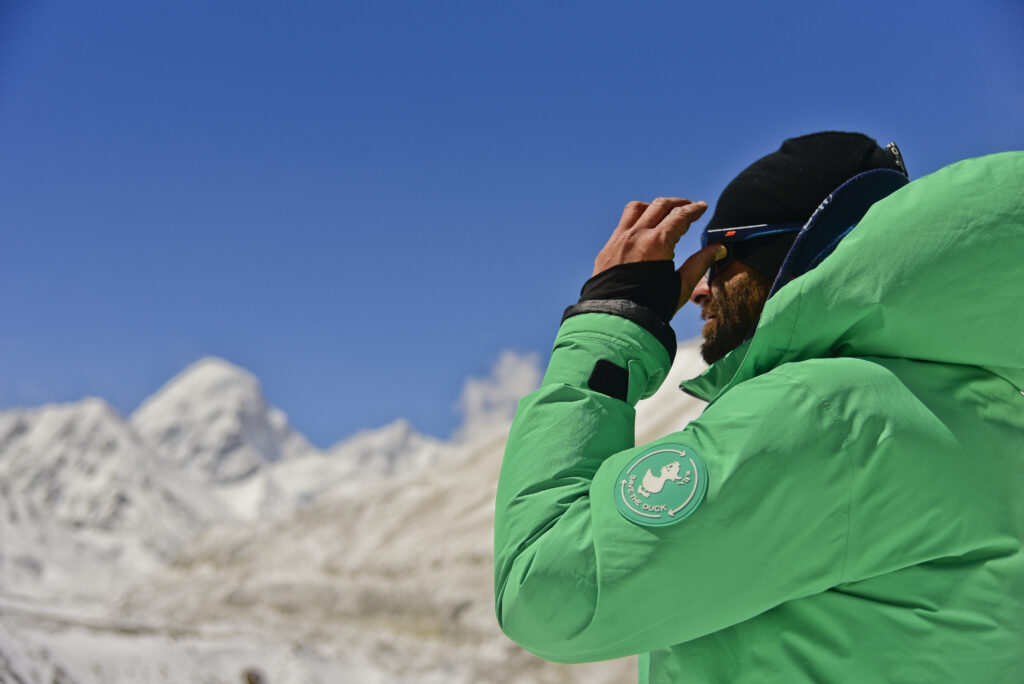
Good news was on the horizon, though. After I contacted Save the Duck, we worked together for eight months and finally, and they built me a custom one-piece suit! The Save the Duck team also built a 100% recycled custom base camp animal-free jacket for me that I could use at altitudes as high as 7000meters. This is my go-to jacket that I wear at base camp, and advanced base camp on big mountains, as well as 6000m and 7000m summits. For instance, I climbed to the top of Kilimanjaro in Africa, as well as Aconcagua in South America using this very jacket and the jacket protected me in high wind and cold conditions.
At the moment, the gear built by Save the Duck that I used on Lhotse and Everest is not available commercially and was custom built for me. So hopefully the next step would be to make this gear available commercially so that mountaineers across the world can make cruelty free and sustainable choices. Synthetic gear is warm, keeps one safe, and above all is good for the animals and the planet.
- How do they support your work as a professional athlete?
Save the Duck has been one of the most amazing brand collaborations that I have been part of. It is like a dream come true. Not only do they build custom gear for me (depending on my needs) for my climbing expeditions, they also outfit me with all the cold weather gear that I require for city or transit purposes. In addition to this, Save the Duck also sponsors my climbing expedition from a monetary perspective. But above all, they believe in my cause of veganism and animal-free. And in return, all they expect me to do is be the best role model that I can be in terms of Veganism, and go do what I love – climbing mountains. Last but surely not least; is to provide them with solid feedback that can help improve the quality of their products.
- What’s the strangest place you’ve ever worn them?
I’m going to change the question, and share the coolest place I’ve ever worn them 🙂
Top of Mt. Everest – both cool literally and metaphorically!!
- You are the first vegan ever to conquer the summit of Mt. Everest, tell us a bit more about how your vegan lifestyle helped support that dream?
I’m not going to sit here and make comparisons between a vegan lifestyle, and a non-vegan one, but rather focus on how a vegan lifestyle helped me immensely with my Everest dream.
For me, when I shifted to eating a well balanced vegan diet, I instantly saw performance benefits during my training at sea-level. My recovery time improved, and I could train harder and harder for the big mountain climbs! One of the biggest benefits and something that is not very obvious or tangible is the amount of mental peace and focus that I derived from making this lifestyle change. Knowing that no animal or sentient being had died for me to be able to pursue my dreams gives me a lot of peace of mind to focus and achieve my dreams.
If you are not already sold on the health benefits of this lifestyle, then I’d say go vegan for the mental edge that this guilt-free lifestyle gives you! And having climbed Everest (twice) and multiple other mountains, I know that in the end mental fitness plays a crucial role in one’s success.
Another advantage I have over other climbers and that I have now been noticing for the past few expeditions is that I never catch a stomach infection. Most mountaineers at some point or the other during their expeditions catch a stomach bug that causes intense stomach pain, loose motions and these climbers tend to get weak and some of them never recover and go home. In my opinion, most of these stomach issues are caused due to bugs most likely from animal foods. As a Vegan, I don’t consume any animal foods, which means that chance of catching infections is quite low. I have also recommended to my co-climbers to go Vegan when they catch an infection and it has worked wonders for most of them!
- Could you also share with us what other summits you still have to climb, figurative or real!
My next dream is combining two extreme ends within the fitness world. On one hand, I want to compete in a professional natural bodybuilding competition, and then within 3-4 weeks of the competition go and climb a big mountain in the Himalaya. My end goal here is to demonstrate that not only can Vegans build top-level endurance, but also put on some serious muscle, and do both together. My hope is to achieve this dream in the next 2 years or so.